In the one Purusha's bearing of maintenance-creation-dissolution the designation for dissolution is Hara: 'sthityadaye hari-virinci-hariti samjnah' (SB 1.2.23).
Shiva
शिव
Also known as हरः · शूलपाणिः · गिरिशः · वामदेवः · रुद्र · नीललोहितः · भवः · मन्युः
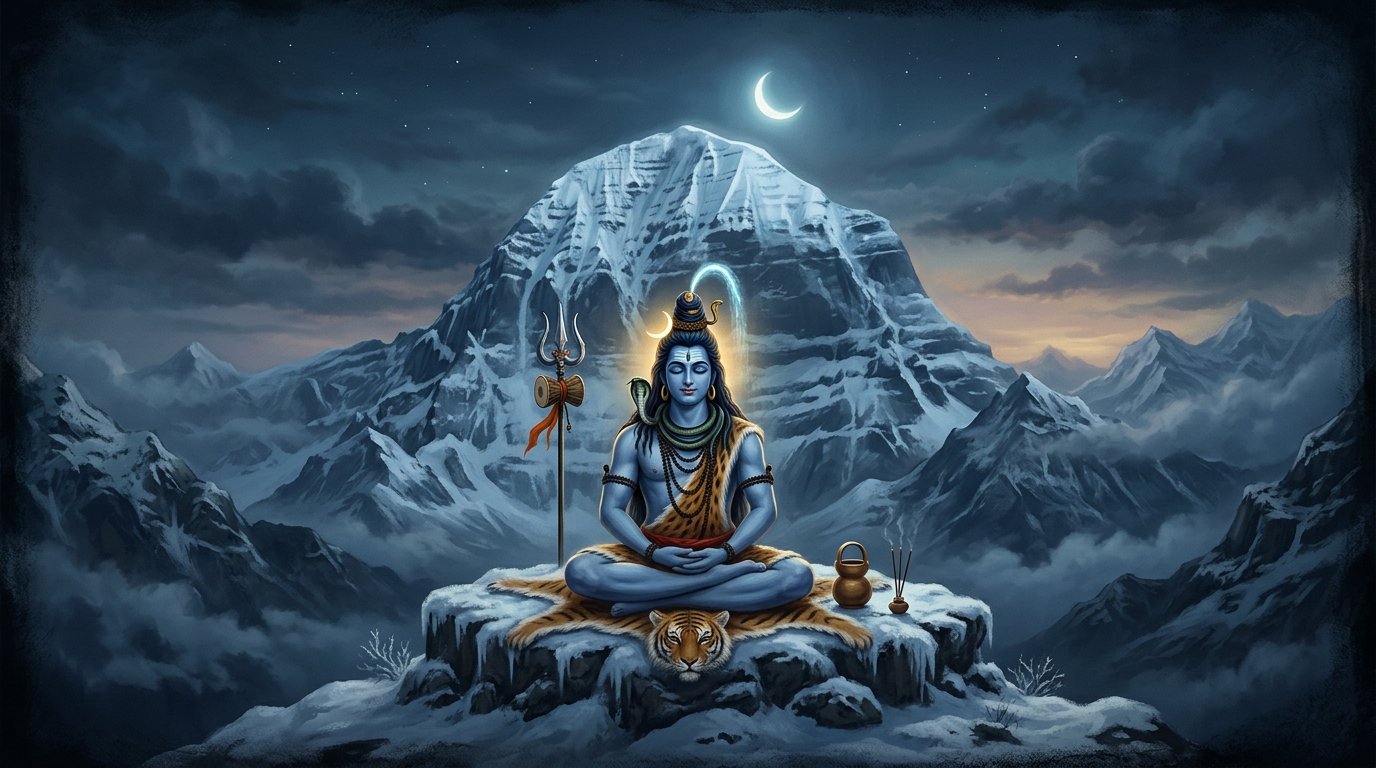
Shiva is the third great god of the Hindu trimurti: the presiding deity of dissolution, the Mahayogi of Kailasa, worshipped across India in linga form, with Uma-Parvati as his consort. In the processed verses (SB 1.2.23) he appears as Hara — the designation borne, with Hari (maintenance) and Virinci (creation), for the function of dissolution within the one supreme Purusha's assumption of prakriti's modes. The verse describes functional designations of the one Purusha, not Shiva's personal identity with Krishna; recorded as stated, with no identity-edge inserted.
Śrīmad Bhāgavata Mahāpurāṇa 1.2.23 — Sanskrit Wikisource (pinned oldid=110173)
Shiva is the son of Brahma. Source evidence (SB 3.12.7): At SB 3.12.7 the anger of the Prajapati Brahma was born from between his brows as Kumara Nila-lohita, who is Shiva.
Husband Uma DeityShiva is the husband of Uma. Source evidence (SB 2.3.7): Uma is the wife of Shiva; at SB 2.3.7 one who seeks conjugal happiness is to worship 'umam satim', and in the same verse learning is sought from 'girisham', Shiva — the two named as a pair. Evidence: STRONG_CONTEXT. Additional source (SB 3.12.13): Shiva is the husband of Uma. Source evidence (SB 3.12.13): At SB 3.12.13 Brahma tells Rudra that the eleven Rudranis, Uma among them, are his wives: 'rudrANyo rudra te striyaH'.
At SB 3.12.12. Manu and Kala here are names of Rudra, not the separate Manu or Kala entities.
At SB 3.12.13 these are explicitly called the wives of Rudra.
At SB 3.12.11 Brahma says these were made beforehand.
Shiva knows Krishna's most secret glory: 'asyanubhavam bhagavan veda guhyatamam shivah' (SB 1.9.19). Evidence: EXPLICIT.
Shiva, astonished in battle, gave Arjuna His own weapon: 'bhagavan yudhi shulapanir vismapitah sagirijo 'stram adan nijam me' (SB 1.15.12), with Parvati beside Him. Direction: giver -> receiver. Evidence: EXPLICIT.
At SB 3.12.7.
Hara destroys under His control: 'srijami tan niyukto 'ham haro harati tad-vashah, vishvam purusha-rupena paripati tri-shakti-dhrik' (SB 2.6.31) — the division of the trimurti's work stated with strict subordination. Evidence: EXPLICIT.