Source of creation, sustenance and dissolution
From Him all that has a beginning proceeds: 'janmady asya yatah' (SB 1.1.1).
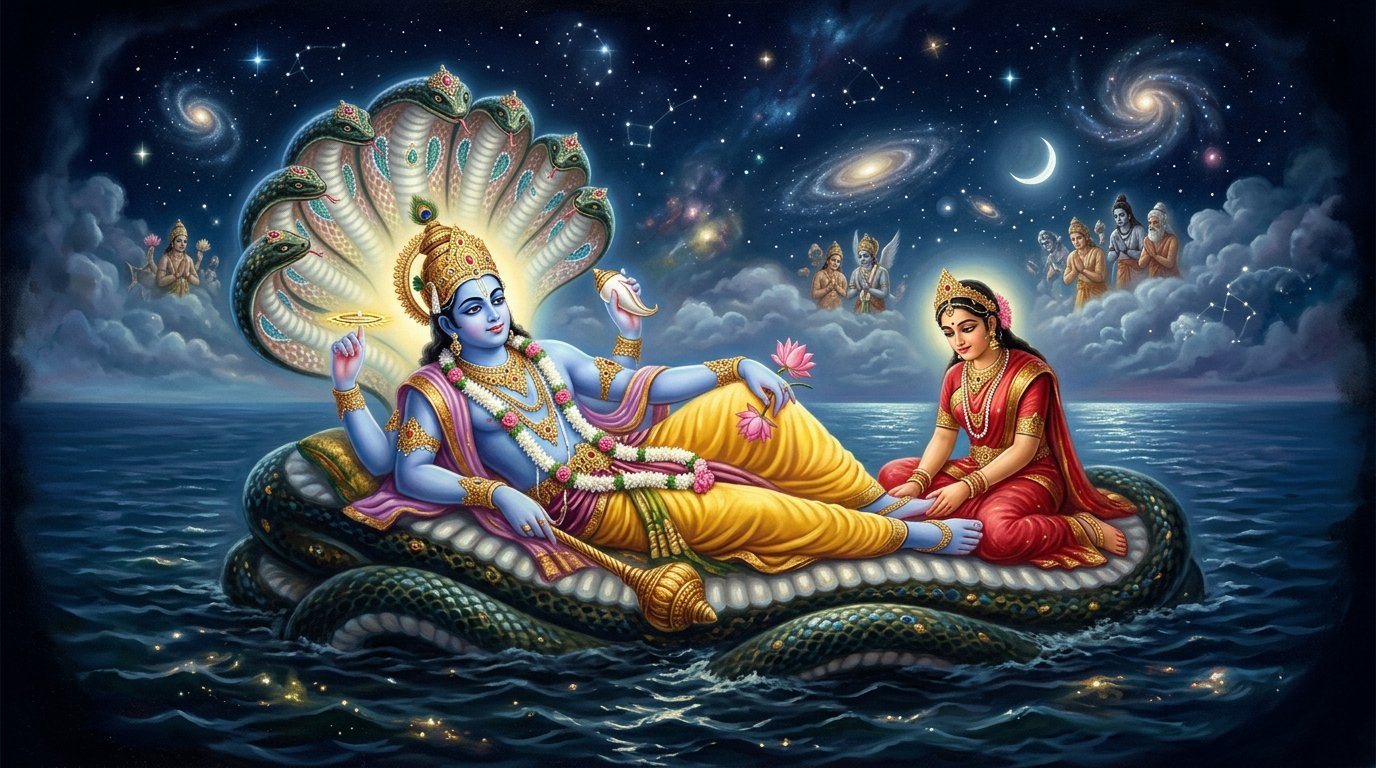
श्रीकृष्ण
Also known as वासुदेव · हरिः · केशव · अधोक्षज · उत्तमश्लोक · योगेश्वर · पुण्यश्लोक · नारायण
Krishna (Vasudeva) is the most widely worshipped divinity of Hinduism, source of all incarnations. SB 1.4.31 — Vyasa's self-diagnosis concludes: the Bhagavata-dharmas are dear to Him — 'priyāḥ paramahāṁsānāṁ ta eva hy acyuta-priyāḥ'.
Śrīmad Bhāgavata Mahāpurāṇa 1.1.1 — Sanskrit Wikisource (pinned oldid=110172)
Krishna is the son of Vasudeva. Source evidence (SB 1.1.12): Krishna, the Lord of the Satvatas, was born of Devaki begotten by Vasudeva: 'devakyam vasudevasya jatah yasya cikirshayaya' (SB 1.1.12) - genitive 'vasudevasya' marks the father. Evidence: EXPLICIT. Direction verified: Krishna -> father.
Teacher Arjuna KingKrishna is the teacher of Arjuna. Source evidence (SB 1.9.36): Krishna removed Arjuna's wrong understanding by the science of the Self: 'kumatim aharad atma-vidyaya' (SB 1.9.36) — a reference to the Bhagavad-gita. Direction: teacher -> pupil. Evidence: EXPLICIT.
Teacher Brahma DeityKrishna is the teacher of Brahma. Source evidence (SB 1.1.1): The Supreme Lord imparted the Veda (brahma) into the heart of the first sage. Sanskrit: 'tene brahma hrda ya adi-kavaye' (SB 1.1.1) - subject 'ya' (the Lord, verb 'tene'), dative 'adi-kavaye' = recipient (Adi-kavi, i.e. Brahma). Evidence: EXPLICIT (recipient named by epithet; Adi-kavi = Brahma is the universal traditional reading). Direction verified: Lord -> Brahma. Additional source (SB 2.2.32): Krishna is the teacher of Brahma. Source evidence (SB 2.2.32): The Lord Vasudeva, worshipped and well pleased, declared these two eternal paths to Brahma of old: 'ye vai pura brahmana aha tushta aradhito bhagavan vasudevah' (SB 2.2.32). Direction: teacher -> hearer. Evidence: EXPLICIT.
Brother Subhadra HumanKrishna is the brother of Subhadra. Source evidence (SB 1.10.7): Subhadra is Krishna's sister: 'svasush ca priya-kamyaya' (SB 1.10.7), He stayed at Hastinapura wishing to please His sister, and at SB 1.10.9 Subhadra is named first among the grieving. Direction: sister -> brother. Evidence: STRONG_CONTEXT.
Father Pradyumna DeityKrishna is the father of Pradyumna. Source evidence (SB 1.10.29): Pradyumna is Krishna's son: at SB 1.10.29 'pradyumna-samba-amba-sutadayah' counts him among the children of Krishna's queens. Direction: son -> father. Evidence: STRONG_CONTEXT.
Son Devaki HumanKrishna is the son of Devaki. Source evidence (SB 1.1.12): Krishna was born of Devaki: 'devakyam... jatah' (SB 1.1.12) - locative of the womb marks the mother. Evidence: EXPLICIT. Direction verified: Krishna -> mother.
Father Samba KingKrishna is the father of Samba. Source evidence (SB 1.11.19): Samba is Krishna's son; at SB 1.11.18 he is counted with Pradyumna and Charudeshna among the sons who come forth at Krishna's arrival, and cf. SB 1.10.29. Direction: son -> father. Evidence: STRONG_CONTEXT.
Father Charudeshna KingKrishna is the father of Charudeshna. Source evidence (SB 1.11.19): Charudeshna is Krishna's son; counted with Pradyumna and Samba at SB 1.11.18. Direction: son -> father. Evidence: STRONG_CONTEXT.
Husband Jambavati HumanKrishna is the husband of Jambavati. Source evidence (SB 1.11.19): Jambavati is Krishna's wife; SB 1.11.18 calls Samba 'jambavati-suta' and Samba is Krishna's son, so she is among His queens. Evidence: STRONG_CONTEXT.
From Him all that has a beginning proceeds: 'janmady asya yatah' (SB 1.1.1).
In His own effulgence He is ever free of illusion and deceit: 'nirasta-kuhakam... dhamna svena' (SB 1.1.1).
Even the learned are astounded by Him: 'muhyanti yat-surayah' (SB 1.1.1).
His avataras occur for the protection and upliftment of living beings: 'yasyavataro bhutanam kshemaya ca bhavaya ca' (SB 1.1.13).
His glory, heard by the purity-seeking, removes Kali's defilement: 'yasah kalimalapaham' (SB 1.1.16).
His magnanimous deeds are sung by the wise; He performs them playfully by His own powers: 'parigitani suribhih... lilaya dadhatah kalah' (SB 1.1.17).
As the Ishvara He plays freely through His own maya in His avatara stories: 'lila vidadhatah svairam isvarasyatma-mayaya' (SB 1.1.18).
Though Bhagavan, He remained concealed, appearing as if an ordinary man while doing what is beyond mortals: 'gudhah kapatamanushah' (SB 1.1.20).
With a single mind the Lord of the Satvatas is to be heard, glorified, meditated on and worshiped: 'srotavyah kirtitavyas ca dhyeyah pujyas ca nityada' (SB 1.2.14).
Dwelling within the hearts of those who hear His story, He removes the inauspicious, the friend of the pious: 'hrdy antah-stho hy abhadruni vidhunoti suhrt satam' (SB 1.2.17).
For the eager, faithful hearer, relish for Vasudeva's stories arises by serving the great and frequenting holy tirthas: 'mahat-sevaya viprah punya-tirtha-nisevanat' (SB 1.2.16).
As one fire hidden in wood appears as many in its sources, so the Vishvatma Purusha in beings: 'yathavahito vahnir darusv ekah sva-yonisu' (SB 1.2.32).
Having entered His own creations - the subtle elements, senses and mind - He experiences their qualities: 'sva-nirmitesu nirvishto bhunkte bhuteshu tad-gunan' (SB 1.2.33).
The Nourisher of the worlds nurtures them through sattva, delighting in playful avataras among gods, beasts and humans: 'bhavayaty esha sattvena lokan vai loka-bhavanah' (SB 1.2.34).
Free of the modes, yet entered within the sporting modes He appears as if endowed with them, expanded by consciousness: 'guneshu gunavan iva antah-pravishto abhati' (SB 1.2.30-31).
'Hareh sattva-nidher dvijah... yathavidasinah kulyah sarasah syuh sahasrasah' (SB 1.3.26).
'Ete camsa-kalah pumsah krishnas tu bhagavan svayam' (SB 1.3.28) — the chapter's mahavakya.
'Ya etat prayato narah sayam-prater grnan bhaktya duhkha-gramad vimucyate' (SB 1.3.29).
'Janmani karmani hy akartur ajanasya ca varnayanti sma kavayo veda-guhyani hrt-pateh' (SB 1.3.35).
'Sa va idam visvam amogha-lilah srjaty avaty atti na sajjate 'smin bhutesu catarhitatma-tantrah' (SB 1.3.36).
'Namani rupani mano-vacobhih santanvato nata-caryam ivajnah... na casya kashcin nipunena dhatur aveti' (SB 1.3.37).
'Evam drastari drisyatvam aropitam abuddhibhih' (SB 1.3.31).
'Atha iha dhanya bhagavanta ittham yad-vasudeve 'khila-loka-nathe kurvanti sarvatmakam atma-bhavam' (SB 1.3.39).
'Bhāgavatā dharmā... priyāḥ paramahāṁsānāṁ ta eva hy acyuta-priyāḥ' (SB 1.4.31).
'Naishkarmyam apy acyuta-bhava-varjitam na shobhate' (SB 1.5.12).
'Na vai jano jatu kathancanavrajen mukunda-sevanya-vadanga-samsritim' (SB 1.5.19).
'Idam hi vishvam bhagavanivetaro yato jagat-sthana-nirodha-sambhavah' (SB 1.5.20).
'Idam hi punsas tapasah shrutasya va... yad uttama-sloka-gunanuvarnanam' (SB 1.5.22).
'Dhyayatas caranambhojam... hrdy asin me sanair harih' (SB 1.6.17).
'Avipakva-kashayanam durdarso 'ham kuyoginam' (SB 1.6.22).
'Mat-kamah sanakaih sadhu sarvan mucati hric-chayan' (SB 1.6.23).
'Bhava-sindhu-plavo drishto hari-caryanu-varnanam' (SB 1.6.35).
'bhaktanam abhayankara' (SB 1.7.22 — Arjuna's prayer).
'jahy astra-teja unnaddham astra-jno hy astra-tejasa' (SB 1.7.28).
'bhuteshu kalasya gatim darshayann apratikriyam' (SB 1.8.4).
'vyasanam vikshya tat tesham ananya-vishayatmanam' (SB 1.8.13) — the protection is granted specifically to those of undivided heart.
'janmaishvarya-shruta-shribhir edhamana-madah puman naivarhaty abhidhatum vai tvam akinchana-gocaram' (SB 1.8.26).
'na yasya kashcid dayito 'sti karhicid dveshyash ca yasmin vishama matir nrinam' (SB 1.8.29).
'sva-nigamam apahaya mat-pratijnam ritam adhikartum avapluto rathasthah' (SB 1.9.37) — He leapt from the chariot, seized its wheel, His upper garment falling.
'kumatim aharad atma-vidyaya yash carana-ratih paramasya' (SB 1.9.36) — the teaching to Arjuna who had turned from slaying his kin.
'vamsham kuror vamsha-davagni-nirhritam samrohayitva' (SB 1.10.2) — the fruit of shielding Parikshit in the womb (SB 1.8.14).
'ya eka asid avishesha atmani agre gunebhyo jagad-atmanishvare' (SB 1.10.21, spoken by the city women).
'ya eka isho jagad-atma-lilaya srijaty avaty atti na tatra sajjate' (SB 1.10.24).
'yada hy adharmena tamo-dhiyo nripa jivanti... bhavaya rupani dadhad yuge yuge' (SB 1.10.25).
'atmaramam purna-kamam nija-labhena nityada' (SB 1.11.4) — offering Him gifts is like showing a lamp to the sun.
'tvam eva matatha suhrit-patih pita tvam sad-gurur nah paramam ca daivatam' (SB 1.11.7, spoken by the people of Dvaraka).
'ashvasya cashvapakebhyo varaish cabhimatair vibhuh' (SB 1.11.23) — bowing, embracing, touching hands, smiling and glancing for all alike.
'prasada yatra patninam sahasrani ca shodasha' (SB 1.11.31) — these are the women freed at the slaying of Bhauma (SB 1.10.29).
'vidhaya vairam shvasano yathanalam mitho vadhenoparato nirayudhah' (SB 1.11.35) — as wind kindles fire.
'etad ishanam ishasya prakriti-stho 'pi tad-gunaih na yujyate' (SB 1.11.39); women before whom even Madana drops his bow could not disturb His senses (SB 1.11.37).
'vavande shirasa sapta devaki-pramukha muda' (SB 1.11.29); the mothers took Him on their laps and bathed Him in the water of their eyes (SB 1.11.30).
'sa samyunakti bhutani sa eva viyunakti ca' (SB 1.13.41); like the joining and parting of playthings, all this is by the Lord's will (SB 1.13.43).
'evam balishthair yadubhir mahadbhir itaran vibhuh yadun yadubhir anyonyam bhu-bharan sanjahara ha' (SB 1.15.26); the brahmana's curse and the varuni liquor were the occasions (SB 1.15.22-23).
Truth, purity, compassion, forbearance, renunciation, contentment and the rest (SB 1.16.28-30); 'ete canye ca bhagavan nitya yatra mahagunah... na viyanti sma karhicit' (SB 1.16.31).
'yasmin harir bhagavan ijyamana ijyatma-murtir yajatam sham tanoti... antar bahir vayur ivaisha atma' (SB 1.17.34).
'sad-udbhava-sthana-nirodha-lilaya grihita-shakti-tritayaya' (SB 2.4.12) — the aphoristic answer to Parikshit's threefold question (SB 2.4.6-7).
'dravyam karma ca kalash ca svabhavo jiva eva ca, vasudevat paro brahman na canyo 'rtho 'sti tattvatah' (SB 2.5.14) — the answer to the rival theories of causation listed at SB 1.17.17-20.
'dharto cchilindhram iva sapta-dinani sapta-varsho mahidhram anaghaika-kare salilam' (SB 2.7.32) — to protect Vraja when the sacrifice to Indra was stopped.
'aham evasam evagre nanyad yat sad-asat param, pashcad aham yad etac ca yo 'vashishyeta so 'smy aham' (SB 2.9.32); the definition of maya (33), and the method of positive and negative concomitance (35).
'tapo me hridayam sakshad atmaham tapaso 'nagha' (SB 2.9.22); 'srijami tapasaivedam grasami tapasa punah, bibharmi tapasa vishvam' (SB 2.9.23).
In the assembly Krishna is called the teacher of the worlds: 'jagad-gurur yAni jagAda kR^iShNaH' (SB 3.1.9).
Vidura walked the holy stations which the Thousand-formed One had himself established: 'svadhiShThito yAni sahasramUrtiH' (SB 3.1.17).
Vidura says the Lord appeared as the Unborn among the Yadus for the sake of those who take refuge: 'arthAya jAtasya yaduShv ajasya' (SB 3.1.44-45).
Beheld at Yudhishthira's rajasuya, Krishna was known by the three worlds as the source of their welfare, and they judged that the Maker's skill had come down here in full: 'nirIkShya dR^ik svasty-ayanaM trilokaH' (SB 3.2.13).
When His own peaceful forms were pressed by other forms, the compassionate Lord of the higher and lower took birth joined with His mahat portion, though unborn — as fire in wood: 'hy ajo 'pi jAto bhagavAn yathA agniH' (SB 3.2.15).
The Lord, self of the universe, followed the path of the world and the Veda and enjoyed desires at Dvaraka, yet remained unattached and established in sankhya: 'kAmAn siSheve dvArvatyAm asaktaH sA~Nkhyam AsthitaH' (SB 3.3.19).
The Lord says that in His first creation He told, to Aja seated on the lotus in His navel, that supreme knowledge which reveals His glory and which the sages call the Bhagavata: 'purA mayA proktam ajAya nAbhye padme niShaNNAya mamAdi-sarge' (SB 3.4.13).
The Lord's thought was that Uddhava is not less than Him even by an atom, for he is a lord untouched by the gunas; therefore let him stay, making the Lord's way known to the world: 'na uddhavo aNu api man-nyUno yad guNaiH na ArditaH prabhuH' (SB 3.4.30-31).
Maitreya's account: in the beginning the Lord alone was, the Self of selves, all-pervading; then He was the seer but saw nothing to be seen, and took Himself as though not existent — 'mene asantam iva AtmAnaM supta-shaktir asupta-dR^ik' (SB 3.5.23-24).
At SB 3.6.34 the four varnas are described as worshipping Hari, their own teacher, each by his own dharma, with faith, for the purification of the self: 'ete varNAH sva-dharmeNa yajanti sva-guruM harim'. Their occupations are mentioned as born with them, so the ground of worship here is one's own dharma.
At SB 3.7.28 the Lord is called 'guNa-avatAraiH vishvasya sarga-sthity-apyayAshrayam' — by the incarnations of the gunas the resort of the creation, maintenance and dissolution of the universe. At SB 3.7.35 He is called the source of dharma and Vidura asks by what He is pleased.
At SB 3.8.10, in the flooded universe, He lies alone on the couch of the serpent king, without desire, delighting in His own self. At SB 3.8.11 He places the subtle elements within His body and rouses the power whose nature is time, 'yathAnalo dAruNi ruddha-vIryaH' — as fire in wood with its force held back. At SB 3.8.12, sleeping a thousand cycles of the four yugas, He sees the worlds taken into His own body.
At SB 3.9.29-30 the Lord says: 'mA veda-garbha gAs tandrIM sarga udyamam Avaha' and 'bhUyas tvaM tapa AatiShTha vidyAM chaiva mad-AshrayAm'. At SB 3.9.32 He sets the condition that only when the world sees Him in all beings as fire in wood will distress be cast off. At SB 3.9.35 He says that rajas does not bind the first of the rishis, because even while creating, his mind is fastened on the Lord.
Krishna is the Lord (pati) of the Satvatas: 'bhagavan satvatam patih' (SB 1.1.12; repeated 1.2.14). Evidence: EXPLICIT.
Chanting His name even helplessly, one fallen into the terrible samsara is freed at once - from that which even fear itself fears: 'yan-nama vivaso gtranan... sadyo vimucyeta' (SB 1.1.14). Evidence: EXPLICIT. Direction verified: the Lord (through His name) is the liberator; samsara is the bondage.
The Lord's glory removes the defilement of Kali: 'yasah kalima-lapaham' (SB 1.1.16). Evidence: EXPLICIT.
Krishna is dharma's very armor/refuge: 'brahmanye dharmavarmapi' - addressed as Dharma-varman, the protector in whom dharma is safeguarded (SB 1.1.23). Evidence: EXPLICIT. (Where dharma takes refuge after His departure is the sages' unanswered question - deliberately not inserted.)
United with meditation on Him, the expert cut the binding knot of karma: 'yat-anudhyasinā yuktah kovidah... karma-granthi-nibandhanam chindanti' (SB 1.2.15). Evidence: EXPLICIT.
That very Lord created this [world] in the beginning through His own maya, in the form of cause and effect: 'sa eva idam sasarja agre bhagavan atmamayaya sad-asad-rupaya' (SB 1.2.30). Evidence: EXPLICIT.
Krishna (with Balarama) obtained birth among the Vrishnis: 'vrsnisu prapya janmani' (SB 1.3.23). Evidence: EXPLICIT.
As Bhagavan (with Rama) He removed the earth's burden: 'bhagavan aharad bharam' (SB 1.3.23). Evidence: EXPLICIT.
The devas are kalas (portions) of Hari: 'rsayo manavo devah... kalah sarve harer eva' (SB 1.3.27). Evidence: EXPLICIT.
The Manus are kalas of Hari (SB 1.3.27). Evidence: EXPLICIT.
The Prajapatis too are kalas of Hari: 'saprajapatayas tatha' (SB 1.3.27). Evidence: EXPLICIT.
Krishna appeared in the line of Yadu: 'yadoh priyasya anvavaye' (SB 1.8.32), as sandal on Malaya. Evidence: EXPLICIT.
Krishna wields the Sudarshana chakra: 'sudarshanena svastrena svanam raksham vyadhad vibhuh' (SB 1.8.13) — 'svastrena', with His own weapon. Evidence: EXPLICIT.
Krishna became Arjuna's charioteer: 'sauhridad atha sarathim' (SB 1.9.20) and 'dhrita-haya-rashmini' (SB 1.9.39), holding the horses' reins. Direction: charioteer -> chariot-owner. Evidence: EXPLICIT.
Krishna is the lord of Dvaraka (Kushasthali): 'pashyanti nityam yad-anugraheshitam smitavalokam sva-patim sma yat-prajah' (SB 1.10.27), where the people daily behold their own Lord. Evidence: EXPLICIT.
Krishna was born in the forest of Madhu (Mathura): 'aho alam punyatamam madhor vanam yad esha... sva-janmana cankramanena cancati' (SB 1.10.26). Evidence: EXPLICIT.
He knows every artha directly (anvayat) and indirectly (itaratah): 'arthesv abhijnah' (SB 1.1.1).
He depends on no other being: 'svarat' (SB 1.1.1).
Helplessly chanting His name, one is freed at once - from what even fear itself fears: 'yad-bibheti svayam bhayam' (SB 1.1.14).
After His earthly pastimes He attained His own abode: 'svam kasthanam adhunopete' (SB 1.1.23).
Uddhava calls it the great misfortune of the Yadus that, dwelling with Him, they did not know Hari even as the sun-jewel Krishna set — 'ye saMvasanto na vidur hariM mInA ivoDupam', as fish do not know the moon (SB 3.2.7-8).
By His own maya Krishna appeared, suited to each, in the many houses of those women in a single moment, and wishing to multiply prakriti begot in each ten sons equal to Himself: 'AsAM muhUrta ekesminn AnAgAreShu yoShitAm' (SB 3.3.8-9).
Krishna resolved that when the Yadus, their eyes reddened by pride, quarrel among themselves there is no other means of their destruction — 'mayy udyate antardadhate svayaM sma', engaged by Me they vanish of themselves (SB 3.3.14-16).
Delighting for many years in household life and in yoga both, detachment arose in Him: 'tasya evaM ramamANasya saMvatsara-gaNAn bahUn / gR^ihamedheShu yogeShu virAgaH samajAyata' (SB 3.3.22).
Wishing to withdraw His own clan, the Lord who removes the distress of those who take refuge told Uddhava: 'badarIM tvaM prayAhi', go you to Badari (SB 3.4.4). Knowing the command, Uddhava still chose to follow behind, unable to bear separation from His feet (SB 3.4.5).
When Uddhava laid bare what was in his heart, the lotus-eyed supreme Lord taught him the highest state of the Self: 'ity Avedita-hArdAya mahyaM sa bhagavAn paraH / Adidesha aravindAkSha AtmanaH paramAM sthitim' (SB 3.4.19). Before this He acknowledged that He knows the desire in Uddhava's heart (SB 3.4.11).
Keshava (Krishna) performed superhuman feats together with Rama (Balarama): 'krtavan kila viryani saha ramena kesavah' (SB 1.1.20) - comitative instrumental 'ramena'. 'Rama' = Balarama per the unanimous commentator/translator reading (STRONG_CONTEXT). Evidence: EXPLICIT for the companionship.
Krishna protected Parikshit in the womb: 'sva-mayaya avrinod garbham vairatyah kuru-tantave' (SB 1.8.14), covering the embryo with His own maya. Direction: protector -> protected. Evidence: EXPLICIT.
Krishna freed Devaki from Kamsa's confinement; at SB 1.8.23 Kunti compares her own deliverance to it — 'tvayaiva nathena', by You alone as protector. Direction: rescuer -> rescued. Evidence: STRONG_CONTEXT.
Krishna repeatedly delivered Kunti and her sons — from poison, the fire, the man-eater, the wicked assembly, forest exile, battle and Drauni's weapon (SB 1.8.24). Direction: rescuer -> rescued. Evidence: EXPLICIT.
Krishna slew Bhauma (Narakasura) and freed thousands of captive women: 'yash cahrita bhauma-vadhe sahasrashah' (SB 1.10.29). Direction: slayer -> slain. Evidence: EXPLICIT.
Krishna crushed Caidya (Shishupala) and other mighty ones at the svayamvara and carried off the bride: 'pramathya caidya-pramukhan hi shushminah' (SB 1.10.29). Direction: victor -> defeated. Evidence: EXPLICIT.
Krishna blew the Panchajanya on reaching Anarta: 'dadhmau daravaram tesham vishadam shamayann iva' (SB 1.11.1); the conch reddened by His lips in the cup of His lotus hands (SB 1.11.2). Evidence: EXPLICIT.
Krishna removed the earth's burden without taking up arms, by creating enmity among the kings: 'vidhaya vairam shvasano yathanalam mitho vadhenoparato nirayudhah' (SB 1.11.35) — a reference to the Kurukshetra war. Evidence: EXPLICIT.
The Lord cut the crocodile's mouth with His disc and, taking him by the trunk, mercifully drew Gajendra out: 'cakrena nakra-vadanam vinipatya tasmad dhaste prigrihya bhagavan kripayojjahara' (SB 2.7.16). Evidence: EXPLICIT.
As a mere infant He took the life of Putana: 'tokena jiva-haranam yad ulukikayah' (SB 2.7.27). Evidence: EXPLICIT.
To purify the water He would, sporting in the pool, drive out the serpent of surpassing venom: 'tac-chuddhaye 'ti-visha-virya-vilola-jihvam uccatayishyad uragam viharan hradinyam' (SB 2.7.28). Evidence: EXPLICIT.
The Lord will free Nanda from the fear of Varuna's noose: 'nandam ca mokshyati bhayad varunasya pashat' (SB 2.7.31). Evidence: EXPLICIT.